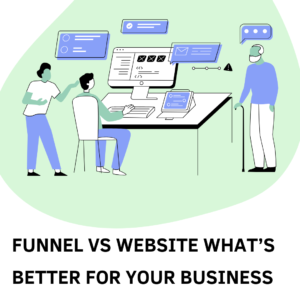
Funnel vs Website: What’s Better for Your Business? (Sales Funnel Strategy, Conversion Rate Optimization & Landing Page Optimization Guide)
In today’s digital landscape, the debate around funnel vs website for lead generation is more important than ever for businesses trying to scale online. Choosing the right sales funnel strategy, combined with effective conversion rate optimization and smart landing page optimization, can determine whether your business struggles or thrives in 2026. Whether you’re learning how to build a high converting sales funnel, searching for the best landing page design for lead generation, or applying conversion optimization tips for beginners, understanding the real difference between funnels and websites is essential for maximizing results.
🚀 Why This Debate Matters in 2026
Businesses today are not failing because they lack traffic—they are failing because they lack conversions.
You might be:
- Running ads
- Ranking on Google
- Posting on social media
But without a structured system, visitors don’t turn into leads or customers.
That’s where the funnel vs website decision becomes critical.
🔍 What Is a Website?
A website is a digital hub that provides information about your business, products, and services.
Key Characteristics:
- Multiple pages (Home, About, Services, Blog, Contact)
- Open navigation menu
- Focus on branding and information
- Designed for exploration
Strengths of a Website:
- Builds brand authority
- Great for SEO and content marketing
- Supports long-term visibility
Weaknesses:
- No guided conversion path
- Users can get distracted
- Lower conversion focus
🎯 What Is a Sales Funnel?
A sales funnel is a structured system designed to guide users toward a specific action.
It is built around a strong sales funnel strategy and focuses on conversions rather than exploration.
Funnel Stages:
- Awareness (traffic)
- Interest (landing page)
- Consideration (nurture emails)
- Conversion (sale or lead)
Strengths of a Funnel:
- High conversion focus
- Eliminates distractions
- Guides user behavior
- Optimized for action
Weaknesses:
- Requires setup effort
- Less flexible for browsing
🧩 Funnel vs Website for Lead Generation: Core Difference
The main difference is simple:
👉 Websites provide information
👉 Funnels drive action
| Feature |
Website |
Funnel |
| Goal |
Information |
Conversion |
| Navigation |
Open |
Controlled |
| Focus |
Multiple |
Single |
| Conversion rate |
Lower |
Higher |
📈 Which Converts Better? Funnel vs Website
When it comes to conversion rate optimization, funnels clearly outperform websites.
Why Funnels Convert Better:
- Focused user journey
- One clear CTA
- Fewer distractions
- Optimized landing pages
A well-built funnel can convert 3x–10x more than a traditional website.
🧠 Sales Funnel Strategy: Why It Wins for Conversions
A strong sales funnel strategy is designed to guide users step-by-step.
Funnel Flow:
- Traffic source (ads, SEO, social media)
- Landing page (lead capture)
- Email nurturing
- Sales page
- Upsell/retention
Each stage is optimized for performance.
🎨 Landing Page Optimization: The Heart of Funnels
A funnel only works if its landing page is optimized.
Effective landing page optimization ensures users take action instead of leaving.
Key Elements:
- Clear headline
- Strong CTA
- Minimal distractions
- Social proof
- Fast loading speed
Without this, even the best funnel fails.
🧩 How to Build a High Converting Sales Funnel
To understand the funnel advantage, you must know how to build a high converting sales funnel.
Step 1: Define Your Audience
Know their problems and needs.
Step 2: Create an Irresistible Offer
Examples:
- Free ebook
- Webinar
- Discount offer
Step 3: Build a Landing Page
This is where best landing page design for lead generation matters most.
Step 4: Capture Leads
Use simple forms and clear CTAs.
Step 5: Nurture Leads
Email sequences build trust.
Step 6: Convert Leads
Use urgency and strong offers.
🎨 Best Landing Page Design for Lead Generation
High-performing funnels rely on optimized landing pages.
Structure of a High-Converting Page:
- Headline
- Subheadline
- Visual element
- Benefits section
- Testimonials
- CTA button
- FAQ section
This structure improves engagement and conversions.
⚡ Conversion Optimization Tips for Beginners
If you’re new, these conversion optimization tips for beginners will help you improve results quickly:
1. Keep It Simple
Less confusion = more conversions.
2. Focus on One Goal
Each page should have one action.
3. Use Strong CTAs
Tell users exactly what to do.
4. Build Trust
Add reviews and testimonials.
5. Test Everything
Use A/B testing to improve performance.
🔄 When to Use a Website Instead of a Funnel
Despite funnel advantages, websites are still important.
Use a Website When:
- Building brand authority
- Publishing blogs
- Showcasing multiple services
- Focusing on SEO traffic
Websites are great for awareness and long-term growth.
🎯 When to Use a Funnel Instead of a Website
Funnels are ideal when your goal is conversions.
Use Funnels When:
- Running paid ads
- Generating leads
- Selling a specific offer
- Promoting webinars or events
Funnels are built for immediate action.
🧠 Psychology Behind Funnels vs Websites
Funnels use behavioral psychology to increase conversions.
Key Triggers:
- Scarcity: Limited offers create urgency
- Social proof: Others influence decisions
- Authority: Expertise builds trust
- Reciprocity: Free value encourages action
- Simplicity: Fewer choices improve decisions
Websites lack this structured psychological flow.
🛠 Tools for Funnels and Websites
To implement a strong sales funnel strategy, use:
Funnel Tools:
Website Tools:
Optimization Tools:
- Google Analytics
- Hotjar
- A/B testing tools
📊 Real-World Example
Let’s compare both approaches:
Website Approach:
- Visitor lands on homepage
- Browses multiple pages
- Gets distracted
- Leaves without converting
Funnel Approach:
- Visitor lands on targeted page
- Sees focused offer
- Takes action
- Becomes lead
👉 Funnels clearly outperform in conversions.
🔮 Future of Funnel vs Website in 2026
The digital landscape is evolving:
Trends:
- AI-driven funnels
- Personalized landing pages
- Automated optimization
- Predictive user behavior
Funnels are becoming smarter and more efficient.
🏁 Final Verdict: Funnel vs Website
So, what’s better for your business?
👉 Funnels win for conversions
👉 Websites win for branding
👉 Best strategy = use both together
💡 Final Thoughts
The debate of funnel vs website for lead generation isn’t about choosing one forever—it’s about using each tool for the right purpose.
A strong sales funnel strategy, combined with effective conversion rate optimization and smart landing page optimization, ensures your business doesn’t just attract visitors—it converts them.
Whether you’re learning how to build a high converting sales funnel, applying the best landing page design for lead generation, or using conversion optimization tips for beginners, remember:
👉 Websites attract traffic
👉 Funnels convert traffic
👉 Optimization drives profit
Use both strategically, and your business will grow faster, smarter, and more efficiently in 2026.